images/dot.gif (43 bytes)
table_left.jpg (782 bytes) dot.gif (43 bytes) table_right.jpg (792 bytes)
dot.gif (43 bytes) dot.gif (43 bytes)
dot.gif (43 bytes)


Earthquake
Reconstruction

dot.gif (43 bytes)


Housing
Upgradation


Infrastructure
Upgradation


Housing
Finance


Infrastructure
Finance


My Home
My Workplace

dot.gif (43 bytes)


What do we do? - Infrastructure Upgradation

Ahmedabad Parivartan through Partnership

The Ahmedabad Parivartan project transforms the physical environment in which informal sector workers live, by providing a package of seven infrastructure services including paved roads, individual toilets, water and drainage connections and street lighting.

The package is provided on an equitable cost sharing basis through a unique partnership between the public sector i.e. the municipality, the private sector and the people’s sector i.e. the community residents, each of whom pay one-third of the total on-site capital cost of service provision.
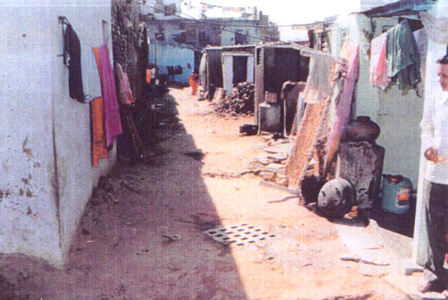
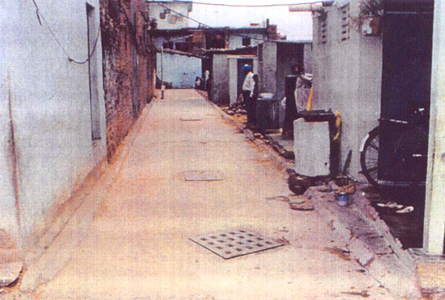
sharifkhan pathan ni chali

sharifkhan pathan ni chali

Sharifkhan pathan ni chali - Before

Sharifkhan pathan ni chali - After

MHT – mobilises the slum communities to participate in the upgradation process and "buy-in" to the project by paying their portion of the total cost. MHT also facilitates the formation of registered "Community Based Associations" over to represent residents’ interest and to help them build their own capacity so that they are able to effectively maintain the newly acquired infrastructure. In MHT’s experience of facilitating the provision of infrastructure to the urban poor, and a sustainable way, some key lessons learned are as follows:

Issues Arising

A. Sector-specific Issues

  1. Microfinance is an enabling tool for improved water and sanitation services.

  2. Access to technical advisory support is vital for the success of credit provision for infrastructure.

  3. Lack of land tenure; lack of traditional collateral - in the sector.

  4. Community and municipal partnership is the key to sustainability.

  5. Regular savings and effective field workers are vital for financial sustainability.

  6. Variety of delivery and implementation mechanisms.

B. India-specific Issues

  1. Microfinance institution models in urban India.

  • Banker's Model

  • Traditional Non-Governmental Organization Model

  • Evolving Community-based Financial Institutions

  • Mainstream Community-based Financial Institutions.

  1. Lack of accurate loan categorization by microfinance institutions-sector volume difficult to quantify.

  2. Institutional funding for infrastructure-sources, blockages and recomendations.

C. India-Specific Future Needs

  1. Need for a National Loan Bridge Fund/Loan Guarantee Fund

  2. Need for capacity-building-communities, microfinance institutions, municipalities and housing finance institutions.

  3. Exploring scaling up.

Top