 |
|
What do we do? - Infrastructure Finance
Meeting the Infrastructure Needs of the Informal Sector through
Microfinance
A five day intensive training program
to build the capacity of Microfinance Institutions and NGOs in collaboration with WSP
& HDFC
Microfinance is a growing sector with great potential for delivering
infrastructure and housing finance to the poor. The role of customers in financing
infrastructure is widely recognized as a key component of long term sustainability of
services and poor communities to make their financial contribution often use small-scale
credit. Although less understood than credit for income generation purposes, the
small-scale infrastructure credit sector is growing. India has a number of
well-established microfinance institutions disbursing loans to poor households for
individual water and sanitation and other infrastructure related purposes.
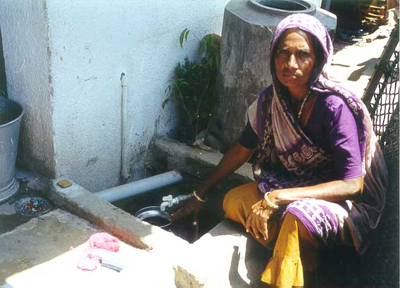
The demand from poor for microfinance
continues to increase but, on the supply side, the sector faces institutional constraints
and insufficient capacity in meeting this growing demand. Substantial upscaling of the
capacity of existing microfinance institutions and the establishment of new institutions
is required. Moreover, while mainstream financing institutions are seeking to channel more
funds into the sector, there is still an enormous potential in the partnerships which can
be developed between major financial institutions, microfinance institutions, municipal
governments, technical agencies and user communities.
The Water and Sanitation Program
– South Asia (WSP – SA) supported a study, Credit Connections,
conducted by the Gujarat Mahila Housing SEWA Trust, to explore the mechanisms of
successful microcredit provision in urban India. It contains case studies of four
microfinance institutions that have successfully facilitated the provision of
infrastructure, including water and sanitation services to poor women in the informal
sector, and highlights the potential of microfinance in improving service delivery to the
lowest income levels. Credit Connections demonstrates the direct relationship between
investments in housing and infrastructure and a rise in incomes of the target families
(poor, informal sector workers) and provides documentary evidence to convince policy
makers that the sector is viable.
Top
The Water and Sanitation Program –
South Asia, in partnership with Gujarat Mahila Housing SEWA Trust, has developed a
training module for microfinance institutions (MFIs) interested in expanding their
activities to include infrastructure provision . Gujarat Mahila Housing SEWA Trust in
collaboration with Friends of Women’s World Banking (FWWB) and supported by WSP
– SA and Housing Development Finance Corporation Limited is organizing a training
program on Meeting the Infrastructure Needs of the Informal Sector through microfinance.
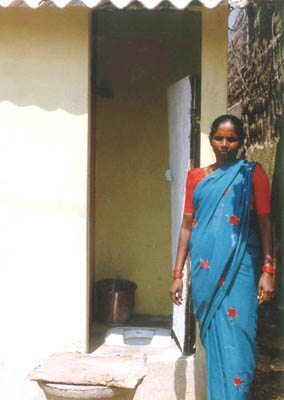
The pilot training is scheduled for
November 2000. It will be held at the Conference Hall, SEWA Bank, Ahmedabad. Participation
is open to all interested micro – finance institutions and NGOs . The nominated
trainees should be experienced in microcredit operations and be in a position to introduce
microfinance for infrastructure upgradation within their own organization following the
training.
Top
The main objective of the training is to build the capacity of MFIs and
NGOs to successfully undertake infrastructure upgradation programs and disburse
infrastructure loans to their clients. Specifically, the training aims to:
Providing information about technical, financial and managerial
aspects of infrastructure projects;
Provide and in-depth insight into Parivartan, the Ahmedabad slum
upgradation program, and share experiences of other infrastructure upgradation programmes
in India and abroad; and
Provide information about the sources of institutional funding
available for infrastructure credit.
Top
The training will address key areas such as:
Designing efficient loan systems for infrastructure credit;
Linkages with public sector agencies;
Planning and project management; and
Sources and procedure of institutional funding for infrastructure
loans.
Top
This course, developed and taught by grassroot practitioners, is
located in Ahmedabad, where a successful citywide slum upgradation program called
Parivartan is underway. Spread over 36 sessions in five days, the training is based on the
experiential learning model and will be conducted in a participatory manner with games,
case studies, role-plays, and group discussions. The trainers include the Managing
Director of SEWA bank, Chief Executive Officer of FWWB, Coordinator of Mahila Housing SEWA
Trust and an international technical consultant. Structured field visits will also be
organized during the training, followed by discussions with all the partners from the
private, public and people’s sector involved in Parivartan.
Top
Please fill the form
to indicate your interest in participation. The pilot training is scheduled for end 2001
and will be conducted in English. Detailed administrative Information including course fee
details will be forwarded to interested participants.
|
