|
|
Awaas Project
The primary objectives of the initiative were:
The primary activities undertaken within the initiative were as
follows:
Study on "Housing Finance and Support Needs of Women in Rural
Areas".
Study on "National and International Sources of Housing
Finance".
Study on "Performance Rating of Selected Government Schemes".
Project partner workshop to present the findings of the studies and
develop a housing finance and technical support model.
Final development of an integrated housing finance system; full
implementation of the system on a pilot basis in one rural district and partial
implementation in two additional districts.
Development of housing finance and technical needs related training
modules; delivery of training program in three rural district level federations to
coincide with pilot.
Development and training in computerization of housing loan related data
at three rural district level federations.
End-of-initiative workshop to share findings and recommendations.
Top
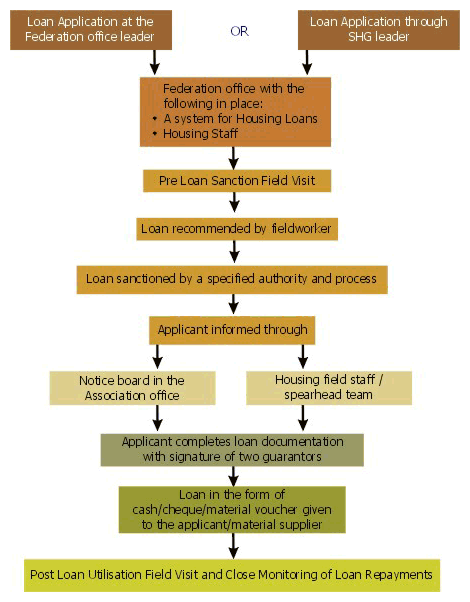
MHT has successfully
developed and implemented a housing finance model. A summary of this model is provided.
The model is currently being used to varying degrees in three districts, and the feedback
on the approach has been very positive. A comprehensive operations manual has been
developed and outlines the steps, processes and documentation that is required to make the
model operational. This model could easily be replicated throughout India. Other districts
in SEWA’s network have already expressed an interest in the system, and have
requested the accompanying documentation and training that is required.
An accompanying training
program has been developed and tested. It includes training modules, visual guides,
training manuals, facilitators’ guides, etc., designed to increase the capacity and
knowledge of implementing agencies so that they can operationalize the new system
effectively. These documents could be readily adapted and duplicated for other
organizations.
A customized FoxPro
database program to record housing loans as well as savings and credit transactions was
developed by MHT. It has been used successfully in the implementation of the pilot, and
can be easily replicated.
Increased demand for
housing loans;
Increased demand for
housing loan staff and housing spearhead team members;
Increased disbursal of
housing loans in pilot district of Kheda (which was unaffected by drought);
Higher loan repayment rates
in district of Kheda.
HUDCO has earmarked Rs. 100
crores for MFIs.
A Project Implementation
Unit (PMI) has been established within HUDCO exclusively for MFI lending.
An internal report on
bottlenecks in MFI lending has been completed by HUDCO.
Top
A number of valuable lessons have
been learned during the implementation of this initiative:
With respect to housing loans:
There is a very high demand for housing loans from poor women in the
informal sector.
Greater flexibility in loan conditions (amount, interest rate, repayment
period) is a major demand/requirement for loans of this nature.
To ensure timely repayment of housing loans, a rigorous site based loan
appraisal system is essential.
Informal sector poor women can and do repay housing loans.
With respect to implementing the pilot system:
A simple, user-friendly software with clear prompts and few
opportunities for error is much more effective than a more sophisticated one (given the
existing capacity at the federation level).
Even with a simple system, it is necessary to provide intensive
technical support and training during the initial stages of computerization.
With respect to related training:
Side-by-side, on-site field training is more effective than classroom
training only.
Top
|